




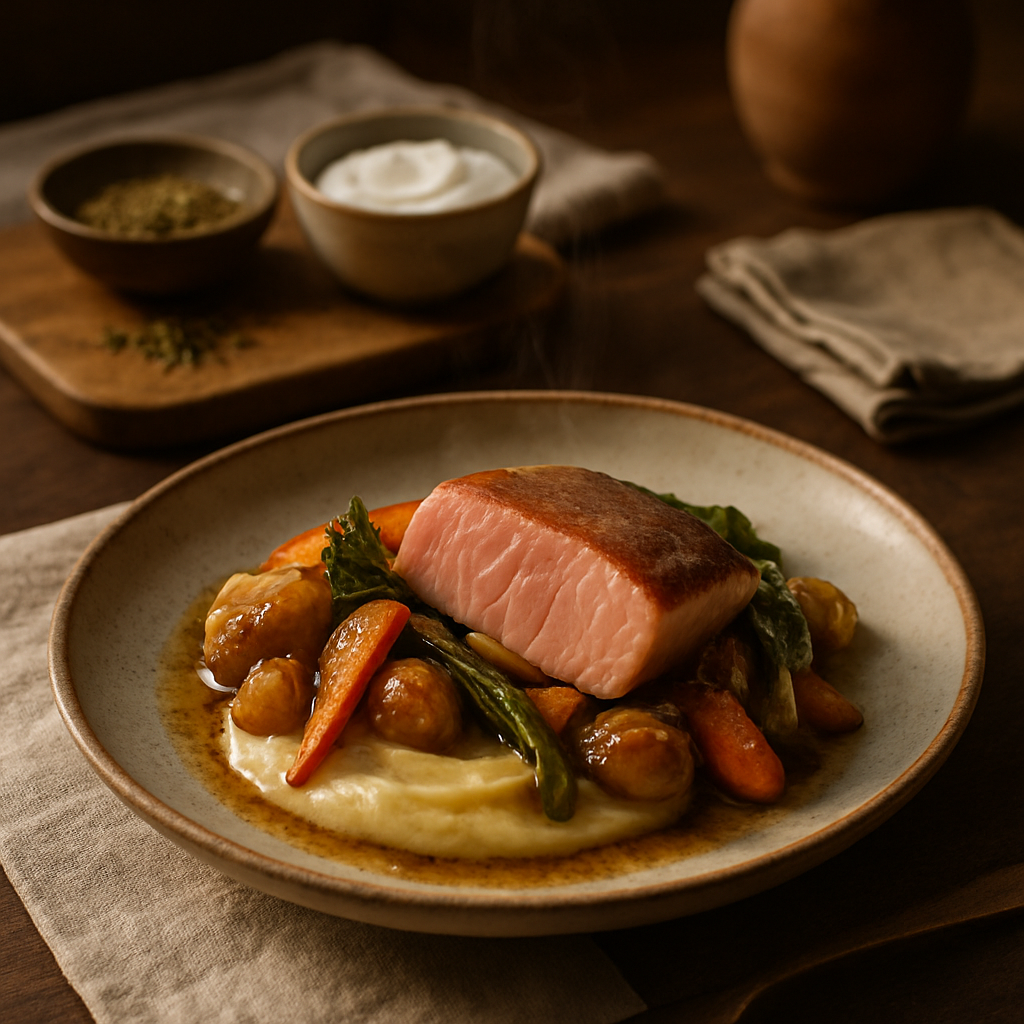
A dish only reaches its truth after the first pause. In the interval when the steam dissipates and the flesh regains its measure, a final language is played out - subtle, patient, decisive.
A breath of fresh air
At the heart of seasonal cuisine, the pause between cooking and serving is not a void: it's a technical breathing space. The temperature continues to act, juices redeposit, sauces thicken without intervention. Braised vegetables regain a denser texture; proteins, after the shock of heat, redistribute their juices. Knowing this time, anticipating it and respecting it, is like writing the last line of a culinary score. We no longer correct: we let what has been done do its work.
The materials speak for themselves
Some ingredients require more time. A chickpea purée, softened by oil and a hint of lemon, becomes more homogeneous if left to rest, the aromas binding together in silence. A roasted eggplant - akin to Levantine preparations - gains in depth if you wait for the smoke to dissipate and the fibers to relax. Rest also reveals fragilities: an overly acidic vinaigrette becomes hard, an overloaded juice loses its freshness. It's at this point that the cook's hand must be restrained and sensitivity acute: knowing when rest is beneficial and when it impoverishes.
The chosen gesture
To withhold a dish is to forbid oneself one more gesture. Here, restraint is not negligence, but moderation. A dish put back on the stove to “refresh” is often the one that will lose its balance. Conversely, a simple veil of paper towel over a meat dish preserves the crust while allowing the center to mellow. Utensils also speak volumes: stoneware dishes hold heat gently, preheated plates accelerate evaporation, a copper cloche retains overly lively aromas. The material choice thus becomes a component of rest, like a silent notation of the desired tempo.
Cultural echoes and sharing
The friction between two cultures - French rigor and Lebanese soul - teaches an aesthetic of foresight. In the Levantine tradition, many preparations are designed to be served after a period of rest: mezzés learn roundness from the night spent, pickles blossom with abandon. Similarly, the French table values the patient construction of a dish. This sharing finds a common territory when composing a meal: plan, assemble, let breathe, then invite. The tempo of service then becomes civism: offering the guest not the instantaneous, but the completed state of flavor.
Perception at your service
When you bring a dish to the table, you need to have already thought about how to read it. The tepidness of a well-settled juice allows olfaction to pick up the low notes; texture that has had time to stabilize reveals itself under the fork with a consistency that is less surprising than reassuring. A dish that has rested invites conversation - it calls less for immediate admiration than for progressive discovery. It's a discreet luxury: patience as an amusing counterpoint to emergence.
In the kitchen, knowing how to suspend means knowing how to listen. Rest is a discreet ingredient, requiring both skill and time. It places cooking in a human rhythm, akin to hospitality, where we offer what we have allowed to mature. In this way, the table becomes a place of endurance and delicacy: an art of living where slowness is never superfluous, but essential.
Conclusion - Sometimes, the simplest thing to do is nothing. In this restraint lies elegance: respecting the time of materials, anticipating their silence, and offering the guest not the instantaneous, but the flavor that has reached its peak. It's a little know-how that goes beyond the kitchen and permeates the way we live. It's the same attention we pay to a suspended conversation, to a loaf of bread gently shared: a balance achieved by the art of stopping before adding.