



In winter cooking, when the smoke has died down and the elements need time to express themselves, infusion becomes a way of speaking without noise. It requires neither the brilliance of a seasoning added at the last second, nor the vanity of a note that dominates. It takes shape from waiting and patience, letting the material reveal itself according to an inner order.
The patient gesture
Infusing means accepting a deferred temporality. We place an herb, a spice or a peel in a liquid and step back, letting the heat, the cold or the oil do their work. Far from being an abdication, the cook's withdrawal is an act of trust. The gesture is measured in degrees, hours, sometimes days, and requires the same precision as cooking fish or kneading dough. Patience is not neutral: it modulates, transforms, rounds out.
Materials that give way
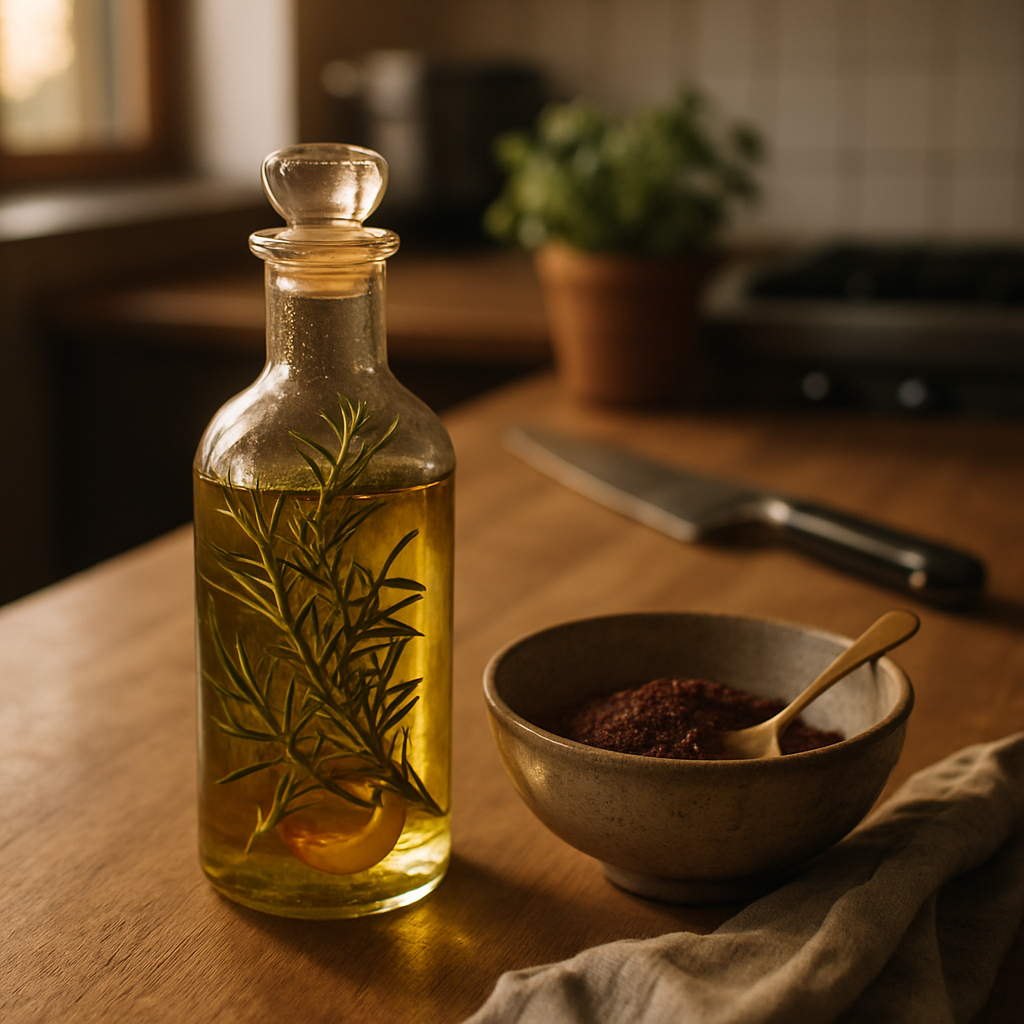
Not all materials lend themselves to infusion in the same way. Levant curd, crème fraîche, medium-fruity olive oil, carcass broth, young vinegar - each accepts and retransmits fragrances according to its own density and memory. In a sumac-spiked yogurt, acidity resonates without impact; in a laurel-infused oil, the leaf yields its subtlest bitters. Gentle supports are often preferred: they welcome aromas without exfoliation, restoring a complexity that emanates rather than attacks.
Technique and discretion
Technically, infusion requires measured choices. Low temperature to preserve volatile notes; slow heat to gently extract bitter compounds; cold maceration to preserve herb freshness. The container counts: glass for transparency, earth for roundness, steel for neutrality. The dosage of aromatics is a matter of balance: a sprig of mint is enough to suggest freshness, a half-spoonful of coriander seeds illuminates the base without blinding it. Knowing how to stop contact at just the right moment is the spice of the operation.
Franco-Lebanese resonances
Levantine cuisine and French tradition meet here without ostentation. The fragrance of za'atar, infused in warm oil, becomes a discreet thread to accompany a fish dish; laurel and rosemary, infused in a broth, add length without emphasis. It's less a question of assembling identities than of finding affinities: Mediterranean restraint side by side with French precision, each respecting the other's space. The infusion becomes a common language, a shape in which the memories of both sides come together.
On the table, a soft voice
Serving an infused element means offering a muted word. A vinaigrette left to infuse the day before provides a base for winter salads, a soft za'atar butter emits discreet warmth on a slice of warm bread, an oil infused with lemon zest wraps a carpaccio rather than streaking it. Infusion creates nuance: the guest receives, discovers and adjusts, without being surprised. Far from being strident, the meal progresses like a conversation, with each proposal allowing time for a response.
Lessons for everyday gestures
Beyond the table, infusion teaches a way of approaching the world: preferring listening to ostentation, favoring the slow formation of things over instant solutions. In the kitchen, as in the art of living, it demands modesty and attention. We learn to choose what to leave to the touch and what to spare; we realize that the strength of a taste does not always lie in its volume, but in the finesse of its presence.
Ultimately, infusion doesn't promise spectacular revelation. It offers continuity: a taste that settles in, accompanies and persists without merging with the chef's voice. It's a school of sobriety that links material, time and service, and discreetly instructs the French art of living, enriched with a hint of the Levant.