




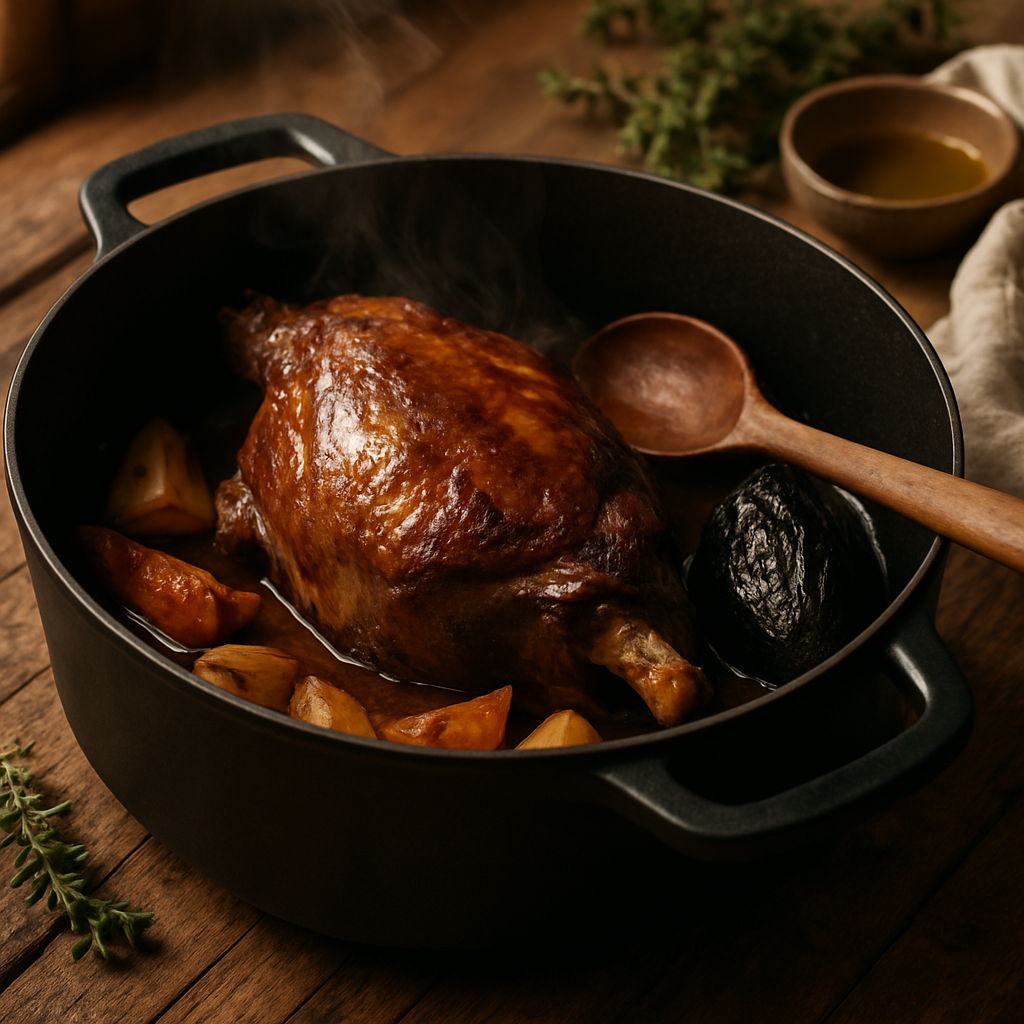
Late winter: the markets still offer tightly packed roots and earthy-smelling herbs. In the kitchen, the unhurried warmth works quietly, relaxing, softening, elaborating a density that we recognize at the first fragment of flesh. In this dilated time, there's a kind of trust - discreet, obstinate - that ends up being heard on the plate.
A silence that works
Extended firing is not a demonstration; it is a prolonged agreement between material and fire. First of all, it requires us to stop: to give up the urgency that characterizes so many contemporary gestures. We enclose a piece of meat, a bunch of vegetables or a thick fish in a temperate atmosphere, and reduce the intensity of the flame to allow the bonds to form. The fibers loosen, the internal sugars recompose, the bitterness subsides. It's not the brightest color that counts, but the hold - that texture that speaks of a steady hand and a time well spent.
Matter that speaks for itself
Slowly, each ingredient finds its own voice. Root vegetables no longer simply offer their initial sweetness; they now tell of the earth that bore them, the dryness of a summer, the freshness of a week's rain. Pieces of meat become less a show of strength than a revealed anatomy: dissolved tendons, transformed collagen, almost domesticated flesh, firm without stiffness. To the light sauce, modest condiments, Levantine spices - a hint of sumac, a veil of za'atar - bring a memory without dominating. This economy of means is faithful to a Franco-Lebanese sensibility that prefers the obviousness of the product to the prestige of the ornament.
Selected gestures
The confidence of slow cooking manifests itself in gestures that are rare but precise. There are moments to baste, to close a lid, to move the pan from a warm corner to a tepid shelf. Above all, there is an art of waiting: tasting without correcting at the first second, smelling the fragrance as it changes, keeping a light hand as the dish begins to give. The river of time calls for a different kind of listening - one that detects the outline of a balance rather than the flare-up of a fleeting intensity.
Time that binds
Slowness is an assemblage: it unites disparate elements into a single gustatory phrase. A muffled broth, vegetables peeled and then cooked for hours, oil applied with the last breath - everything responds to each other. The rest that follows cooking is no innocent interlude; it completes the transformation. Sauces, cooled and then gently reheated, become smoother, juices more stable. In this gesture, cooking becomes an art of patience, where time becomes an invisible binder, a silent accomplice to balance.
A taste of confidence
At the table, slow cooking reveals itself in the exact sensation of holding: the chew offered without brutal resistance, the warmth that lingers, the juices that express themselves without emphasis. It's a form of measured generosity - an invitation to a meal that slows down the guest's pace, leading him to listen. In keeping with a shared Mediterranean tradition, this is a way of receiving that values duration: the meal becomes a ceremony of time, not a spectacle of the moment.
Conclusion - Cuisine as an art of living
Learning to cook slowly means learning to live a little differently. Temperature control, patient gestures and respect for the material impose a rhythm that has repercussions outside the oven: slowing down, accepting indeterminacy, tasting the fidelity of a promise kept. In this kitchen, trust is not an empty word; it can be tasted, measured and, silently, transforms the act of eating into a sensitive discipline of time.